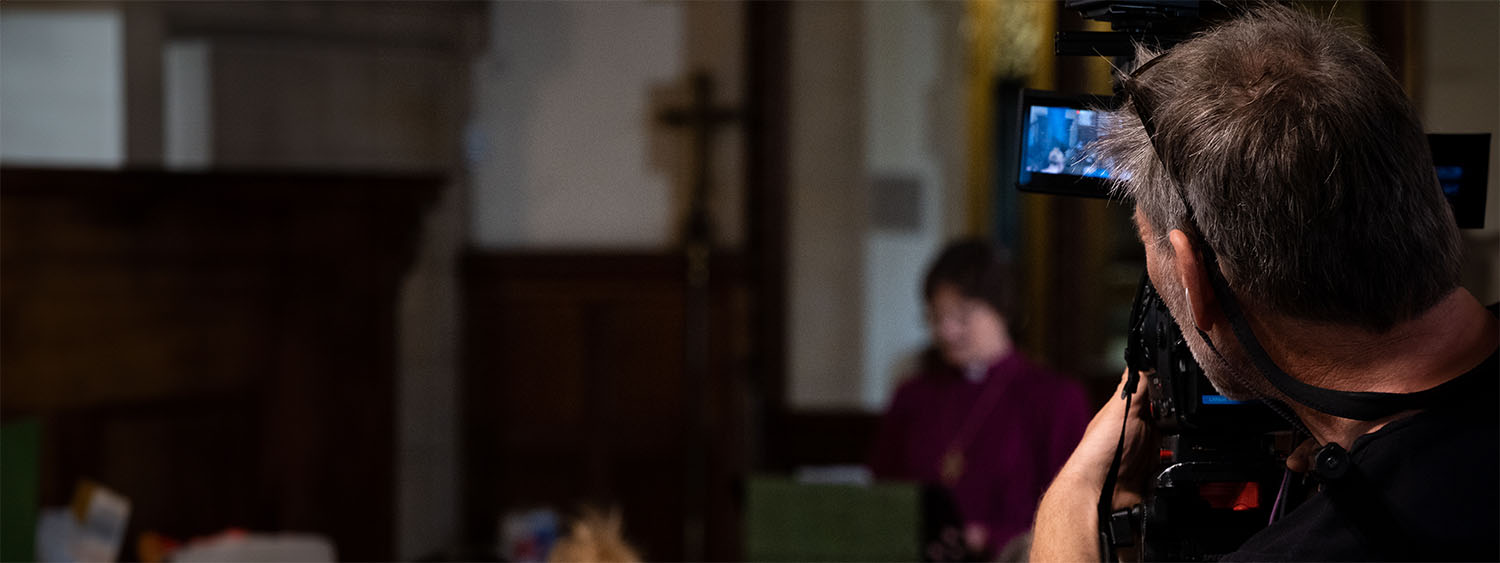
Churches are increasingly asked to livestream services, record key life events, or permit filming in and around their buildings. These activities can be positive and pastorally helpful, but they also raise questions about consent, privacy, copyright, safeguarding and the use of sacred space.
It is for the incumbent and PCC to decide what is appropriate in their context. Parishes are strongly encouraged to agree a clear local policy and to communicate this in advance to congregations and those requesting filming.
1. Livestreaming services and church events
Many churches now livestream regular worship or significant services such as weddings, funerals, confirmations or carol services. When offering livestreaming, consider the following:
Consent and privacy
- People attending should be clearly informed that filming or livestreaming is taking place.
- Display notices at entrances and mention the livestream in the service welcome.
- Where possible, provide areas outside camera view for those who prefer not to be filmed.
- Take particular care when children or vulnerable adults may be present; follow your parish safeguarding policy.
- For occasional offices (especially funerals), discuss recording or streaming sensitively with the family in advance.
Pastoral considerations
- Be mindful that some moments in services are pastorally sensitive (e.g. prayer ministry, communion rails, funerals). You may prefer to fade to black or a pre-prepared image during communion, for example.
- Camera placement and operation should be unobtrusive and should not disrupt worship.
2. Copyright, music and licensing
Recording or streaming services often involves copyright and licensing requirements. Parishes should ensure they have:
- The appropriate music licences for livestreaming or recording hymns and worship songs (for example, CCLI Streaming Licence where applicable).
- Permission to reproduce or display service sheets, lyrics or projections online.
- Consent from choirs, musicians and readers where performances are recorded.
- Permission for modern readings, poems or other texts not in the public domain.
If in doubt, check the terms of your existing parish licences or seek advice before recording.
3. Data protection and GDPR
Livestreaming or recording may involve processing personal data. Parishes should:
- Inform people clearly how recordings will be used and how long they will be kept.
- Avoid unnecessary close-ups of congregations unless consent has been obtained.
- Ensure recordings are stored securely and only shared through agreed channels.
Further guidance is available from the Church of England.
4. Filming for films, television or commercial projects
Church buildings are sometimes requested as locations for films, documentaries, student projects or commercial shoots.
Before agreeing, consider:
Permissions and oversight
- Permission will normally require agreement from the incumbent and PCC.
- For larger productions, a formal location agreement should be used.
- Check whether a faculty or additional permissions may be required from the Diocesan Registry, particularly if equipment, staging or alterations are involved.
Practical considerations
- Impact on regular worship and parish activities.
- Insurance and liability cover.
- Protection of historic fabric and furnishings.
- Supervision while crews are onsite.
Fees
Parishes may charge location fees to cover:
- Heating, lighting and staff time.
- Wear and tear or cleaning.
- Loss of normal use of the building.
Useful practical guidance is available from the Diocese of London.
5. Photography in churches
Photography is common at services and events, but the same principles apply:
- Inform those present before the service (in spoken and written notices wherever possible), clearly detailing how they can opt out or withdraw consent.
- Obtain consent where individuals are identifiable.
- Take particular care with children and safeguarding requirements.
- Avoid photography during prayer or communion unless agreed in advance.
- Ensure photographers understand expectations about decorum and movement during services.
6. Creating a parish policy
A simple written policy helps set expectations and reduces uncertainty. This might include:
- Whether regular services are livestreamed.
- Where cameras are positioned.
- How consent is communicated.
- Expectations for visiting photographers or videographers.
- Who to contact for filming requests.
Policies should be:
- Approved by the PCC.
- Reviewed periodically.
- Shared on the parish website or noticeboard where appropriate.
7. Other issues to consider
You might need to also think about how you and your church will handle the following:
- Safeguarding and online visibility of children or vulnerable adults.
- Background copyright (artwork, projections, or recorded music audible in the building).
- Drone filming, which may require additional permissions and insurance.
- Burial grounds and privacy, especially during funerals or visits to graves.
- Archiving: deciding how long recordings are kept and who may reuse them.